
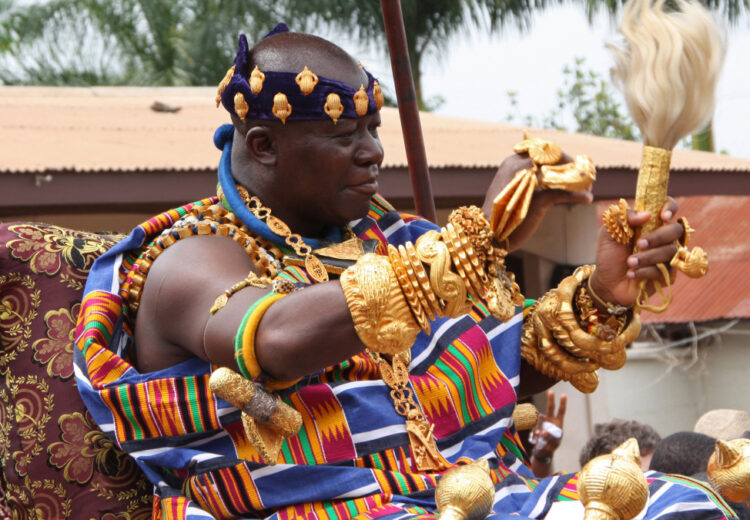
Otumfuo Osei Tutu II Asantehene
The current king of the Ashanti Kingdom. The name Asante means “because of war”. The word derives from the Twi words ɔsa meaning “war” and nti meaning “because of”. This name comes from the Asante’s origin as a kingdom created to fight the Denkyira kingdom..
Asante Empire
The Asante Empire (Asante Twi: Asanteman) was an Akan state that lasted between 1701 to 1901, in what is now modern-day Ghana. It expanded from the Ashanti Region to include the Brong-Ahafo Region, Central Region, Eastern Region and Western Region of present-day Ghana as well as some parts of Ivory Coast and Togo.Due to the empire’s military prowess, wealth, architecture, sophisticated hierarchy and culture, the Ashanti Empire has been extensively studied and has more historic records written by European, primarily British authors than any other indigenous culture of Sub-Saharan Africa.
Starting in the late 17th century, the Ashanti king Osei Tutu (c. 1695 – 1717) and his adviser Okomfo Anokye established the Ashanti Kingdom, with the Golden Stool of Asante as a sole unifying symbol. Osei Tutu oversaw a massive Ashanti territorial expansion, building up the army by introducing new organisation and turning a disciplined royal and paramilitary army into an effective fighting machine.
In 1701, the Ashanti army conquered Denkyira, giving the Ashanti access to the Gulf of Guinea and the Atlantic Ocean coastal trade with Europeans, notably the Dutch.The economy of the Ashanti Empire was mainly based on the trade of gold and slaves.
The army served as the effective tool to procure captives. The Ashanti Empire fought several wars with neighboring kingdoms and lesser organized groups such as the Fante. The Ashanti defeated the British Empire’s invasions in the first two of the four Anglo-Ashanti Wars, killing British army general Sir Charles MacCarthy and keeping his skull as a gold-rimmed drinking cup in 1824. British forces later burnt and sacked the Ashanti capital of Kumasi however, and after the final Ashanti defeat at the fifth Anglo-Ashanti War, the Ashanti empire became part of the Gold Coast colony on January 1, 1902. Today, the Ashanti Kingdom survives as a constitutionally protected, sub-national traditional state in union with the Republic of Ghana.
The current king of the Ashanti Kingdom is Otumfuo Osei Tutu II Asantehene. The Ashanti Kingdom is the home to Lake Bosumtwi, Ghana’s only natural lake. The state’s current economic revenue is derived mainly from trading in gold bars, cocoa, kola nuts and agriculture.
The name Asante means “because of war”. The word derives from the Twi words ɔsa meaning “war” and nti meaning “because of”. This name comes from the Asante’s origin as a kingdom created to fight the Denkyira kingdom.
The variant name “Ashanti” comes from British reports transcribing “Asante” as the British heard it pronounced, as-hanti. The hyphenation was subsequently dropped and the name Ashanti remained, with various spellings including Ashantee common into the early 20th century.
Between the 10th and 12th centuries AD the ethnic Akan people migrated into the forest belt of Southern Ghana and established several Akan states:Ashanti,Brong-Ahafo,Assin-Denkyira-Fante Confederacy-Mankessim Kingdom (present-day Central region)Akyem-Akwamu-Akuapem-Kwahu (present-day Eastern region and Greater Accra), and Ahanta-Aowin-Sefwi-Wassa (present-day Western region).
Interesting Facts about The Ashanti Tribe
The people of this tribe have a slogan: “If I go forward I die. If I go backward I die. Better go forward and die.” When the Ashanti tribe was faced with war, they used drums to signal the upcoming battle. The beat of these drums was so loud, they could be heard through the dense forest over long distances.
The Ashanti have a special handshake. They hold their left hand out to shake hands. That’s because they believe that the left-hand holds the shield, and the right-hand holds the spears. So, in order to show that you trust someone, you put down your shield. That leaves the left hand free.
The Golden Stool is a sacred symbol of the Ashanti nation believed to possess the soul of the Ashanti people. According to legend, the Golden Stool descended from heaven in a cloud of white dust and landed in the lap of the first Ashanti king, Osei Tutu. The king’s priest proclaimed that going forward the strength and unity of the Ashanti people depended upon the safety of the Golden Stool. The Stool was made of gold, stands 18 inches high, 24 inches long, and 12 inches wide. It was never allowed to touch the ground and was considered so sacred that no one was allowed to sit on it. Each new Ashante king is lowered and raised over the Golden Stool without touching it. No one could be considered a legitimate ruler without the Golden Stool.
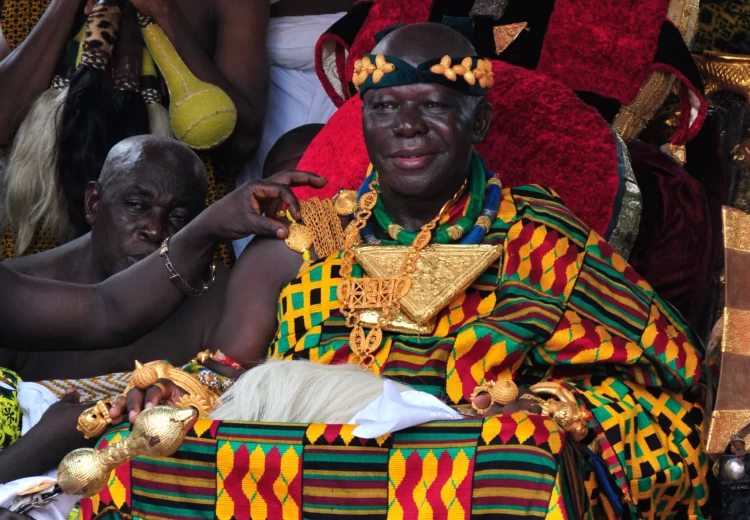
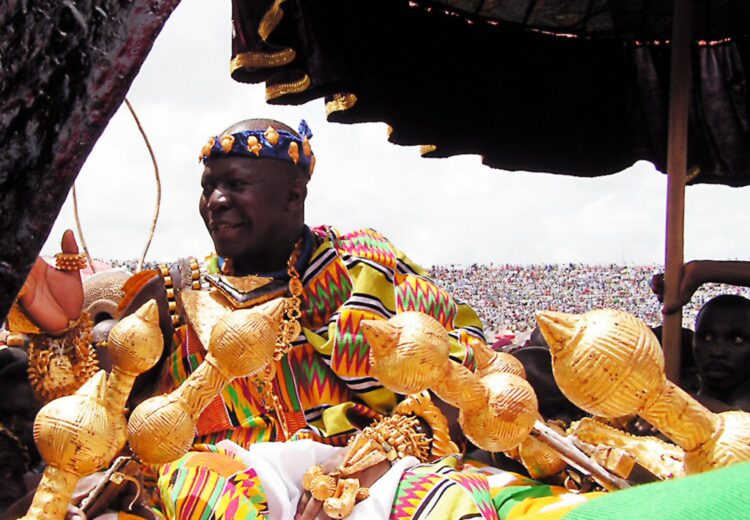
Traditionally the Kente cloth is a festival cloth worn mainly during the annual and seasonal festivals, which are happy occasions. Today they are not only used for festive occasions but also during the rituals associated with the important events of life; for example, marriage, death, and religious worship.